

Happiness with two frames strapped to your feet: that’s how we might describe the passion that is winning over more and more people to this kind of winter hiking. It is an activity appreciated for many reasons, first and foremost because it allows you to immerse yourself in the enchantment of nature with great ease, as happens on very few other occasions.
We would go further: snowshoeing (today the most commonly used term) is perhaps the latest frontier of winter sports, because it is truly accessible to everyone and offers a great sense of freedom. We can choose our own routes and tackle them at any time—not only during the day, but also in the evening hours.
In this way we have the opportunity to “glide” over deserted trails in the magic of the night, by the light of the full moon, in an enchanted landscape. Experiences with a high dose of adrenaline and romance, offered by an ever-growing number of destinations, including in Ticino.
In Jack London’s imagination
Who are snowshoeing enthusiasts? Quite simply, people who love walking in nature and usually do so in summer, but who continue in winter as well, with the chance to enjoy equally exceptional environments. Many also choose this activity to stay away from the hustle and bustle of ski slopes, enjoying the silence of nature.
According to the authoritative Treccani dictionary, the term ciaspole (snowshoes) has an uncertain etymology: for some, it comes from the dialect of Val di Non (Trentino), entering common usage thanks to the success of the “La Ciaspolada” race, founded in 1973, whose latest edition took place last January 7.
Snowshoes, however, have a much older history. The first snowshoes appeared around 6000 BC and were used by peoples living in cold regions of Asia, Canada, and northern America—hunters, farmers, woodcutters, travelers, explorers, and soldiers.
Snowshoes are used to move in winter environments by increasing the surface area of flotation and helping to prevent sinking into the snow. For this reason, humans have often relied on them to carry out their activities and meet basic subsistence needs.
They have also entered the collective imagination thanks, for example, to Jack London, the American novelist and author of White Fang, who loved to recount the exploits of Klondike prospectors. In his stories—later adapted in classic twentieth-century films—men move across the snow with snowshoes on their feet.
Winter itineraries in Ticino
As mentioned, Ticino too seems to be moving in this direction, as snowshoe itineraries described in tourist guides and on related portals are becoming increasingly numerous, marking a clear trend here as well.
After all, very little is needed to practice this discipline: a decent level of fitness, a pair of snowshoes (choosing from a wide range of models), suitable winter clothing (with well-protected boots), and two poles to help maintain balance while walking.
In short, snowshoes are the simplest way to move on snow and enjoy excursions in close contact with nature, and winter hiking has finally found its place here as well among the outdoor activities offered by tourist destinations.
Routes are usually marked with pink signs and are set up specifically for this season. There are regular hiking trails and those dedicated to snowshoeing, indicated by a small symbol depicting their characteristics.
It is recommended to stay on marked routes, not only because they are safer (as they are monitored), but also to avoid disturbing wildlife. Areas where animals are present are generally indicated by green signs.
In winter, it is important not to encroach on these territories, as wildlife has limited reserves during this period. When stressed, for example by human presence, and forced to flee, animals consume a great deal of energy unnecessarily, putting their survival at risk.
An excursion to Capanna Gorda
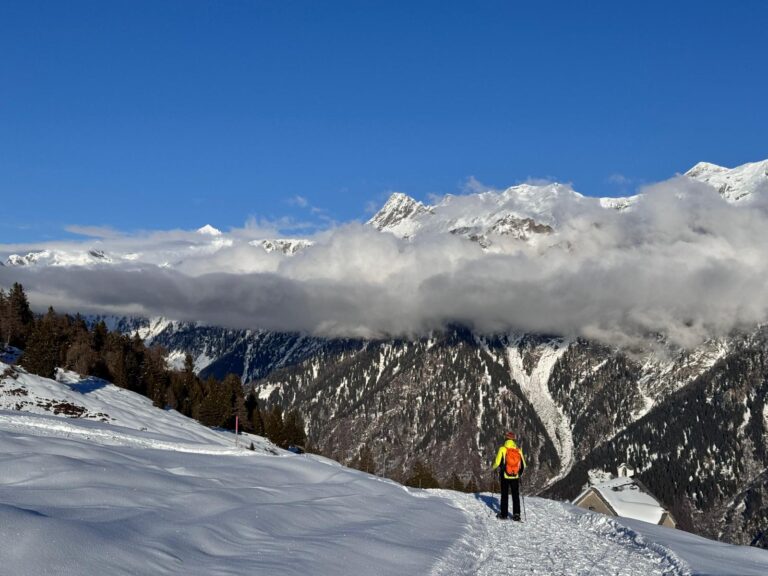
Today’s proposal takes us to discover an interesting itinerary in the upper Valle di Blenio, starting from the village of Camperio (it is also possible to start from other points) and ending at the beautiful Capanna Gorda, located on a wide plateau at an altitude of 1800 meters.
The route is 6.2 km long and requires about 2 hours and 45 minutes to overcome a 580-meter elevation gain. For the more experienced, it is also possible to continue on to Punta di Larescia, or “Nido d’Aquila” (2194 m): an additional 2.2 km with 611 meters of elevation gain, requiring about 1 hour and 30 minutes.
The snowshoeing experience to Capanna Gorda is fascinating at any time, but perhaps even more so when undertaken in the late hours of the day. At that time, it is possible to witness extraordinary sunsets, with intense light reflecting off the snow-covered peaks, including the Adula massif.
Region: Valle di Blenio, Canton Ticino (CH)
Start: Camperio, 1220 m
Finish: Capanna Gorda, 1800 m
Elevation gain: 580 m
Duration: 2h45’
Difficulty: T1 / T2
Photo: © Nicola Pfund